
Kemp’s Test
Kemp’s Test (also known as the Lumbar Quadrant or Extension-Rotation Test) is an orthopedic maneuver used primarily to assess for lumbar facet joint irritation, facet syndrome, or possible lumbar spinal stenosis. The test aims to reproduce back or leg symptoms by loading the lumbar facet joints and narrowing the intervertebral foramen.
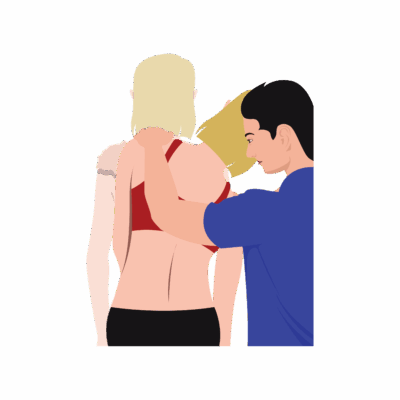
How the Test is Performed
-
Client position: Standing (can also be done seated).
-
Therapist guides or instructs:
-
The client crosses arms in front of the chest.
-
Therapist stabilizes the pelvis and guides the client into lumbar extension, then side-bending (lateral flexion) and rotating toward the side being tested.
-
The final position produces maximum compression/stress on the facet joints and narrows the neural foramina.
-
-
Positive sign: Reproduction of the client’s familiar back pain, local lumbar tenderness, or sometimes leg symptoms (if nerve root is compressed).
Clinical Significance
-
Local back pain during testing suggests facet joint involvement (facet arthropathy or irritation).
-
Radiating leg pain may indicate nerve root compression, possibly from foraminal narrowing, disc herniation, or spinal stenosis.
-
The test is sensitive for provoking symptoms, but diagnostic accuracy for facet joint pain is limited. It should be interpreted as part of a broader exam.
-
Most useful as a screening or provocative test to help guide further assessment rather than a definitive diagnostic tool.
Assessment
-
Use Kemp’s Test in clients with unexplained low back pain, possible facet irritation, or suspicion of lumbar spinal stenosis or nerve root involvement.
-
Document whether pain is local or radiating and describe which movement(s) reproduce symptoms for communication with collaborators and ongoing care.
Treatment
-
If local lumbar pain is reproduced:
-
Avoid aggressive mobilization, deep pressure, or excessive extension/rotation movements during massage. The therapist should focus on gentle soft tissue and myofascial work, pain modulation, and improving movement in other planes.
-
-
If radicular (leg) pain is noted:
-
Avoid techniques that increase neural compression, refer for medical imaging or further evaluation if symptoms are severe or progressive.
-
-
Emphasize posture education, pain-free movement, and gradual strengthening/flexibility within tolerated ranges.
Safety and Referral
-
Always refer for further assessment if severe, progressive, or new-onset radicular symptoms (numbness, weakness, loss of bladder/bowel control) emerge.
-
Collaborate with physiotherapists, spine specialists, or other providers where persistent pain or neurological dysfunction is present.