
Apley’s Compression Test
The Apley’s Compression Test (Apley grind test) is a prone knee test used to help identify meniscal injury by compressing and rotating the tibia against the femur.
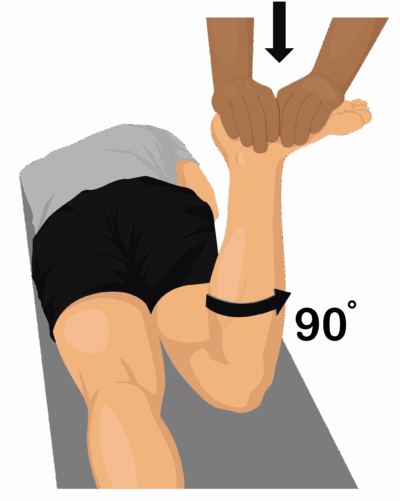
How the Test is Performed
Clinical procedure (orthopedic context):
-
Position:
-
Client lies prone (face down).
-
Test knee flexed to about 90°, opposite leg extended.
-
-
Stabilization:
-
Examiner stabilizes the posterior thigh (often with their own knee or hand) to fix the femur to the table.
-
-
Compression + Rotation:
-
Examiner grasps the lower leg/heel and applies a downward axial load through the tibia (compressing tibia into femur).
-
While maintaining compression, the tibia is internally and externally rotated.
-
-
Positive test:
-
Joint-line pain, clicking, catching, or clear restriction during compression and rotation suggest meniscal pathology.
-
Pain localized medially → suspect medial meniscus; pain laterally → suspect lateral meniscus.
-
Clinical Significance
-
A positive Apley’s Compression Test supports suspicion of meniscal tear or degeneration, particularly after twisting injuries, squatting, or sports trauma.
-
Test accuracy is moderate; it is best viewed as one piece of the diagnostic puzzle, used alongside history, other tests (McMurray, Thessaly), and imaging if needed.
-
Meniscal damage can contribute to locking, catching, joint-line tenderness, swelling, and long‑term OA risk.
Assessment
For a massage therapist, Apley’s Compression is mainly a screening and differentiation tool:
-
Consider using when clients report:
-
Joint‑line knee pain, locking/catching, or pain with rotation/compression (kneeling, squatting, pivoting).
-
-
Observe and note:
-
Location of pain (medial vs lateral joint line).
-
Whether pain is worse with compression but not with distraction (supports meniscus over ligaments).
-
-
Combine with:
-
Palpation of joint lines, ROM, squat pattern, and other ortho tests (if within training and scope).
-
A clearly positive Apley’s Compression Test should push you toward cautious local work and likely referral for medical/physio evaluation rather than aggressive knee treatment.
Treatment
If findings suggest meniscal involvement:
-
Avoid:
-
Deep, aggressive work directly over the joint line.
-
Forceful end‑range flexion/rotation of the knee.
-
Techniques that mimic painful compression (e.g., loaded twisting in flexion).
-
-
Prioritize:
-
Gentle soft tissue work to surrounding structures (quads, hamstrings, gastrocs, ITB, hip muscles) to reduce compensatory spasm and improve mechanics above/below the knee.
-
Work on hip and ankle mobility and overall lower‑chain alignment, which can reduce stress on the meniscus during function.
-
Client education on activity modification: avoiding deep loaded squats, pivoting on a planted foot, or prolonged kneeling until medically cleared.
-
-
In chronic or stable presentations under medical care, massage can support pain modulation, circulation, and movement quality, but not replace specific rehab or surgical decision‑making.
Safety and Referral
-
Do not perform Apley’s Compression and avoid local knee work when there is:
-
Suspected fracture, gross deformity, or high‑energy trauma.
-
Significant acute effusion, hot swollen joint, or suspected infection/inflammatory arthropathy.
-
Recent post‑operative knee (unless explicitly cleared and guided by the surgical/rehab team).
-
-
Red‑flag / refer out when:
-
Client reports locking that requires manipulation to “unlock”, or knee cannot fully extend.
-
Recurrent giving‑way, sharp joint‑line pain, or mechanical catching with daily activities.
-
Rapidly worsening swelling, redness, warmth, or systemic symptoms
-