Outcome measures help you move from “I think this helped” to “Here’s how much this changed.” For massage therapy students, learning to use pain scales and functional tools turns your treatments into measurable, trackable clinical interventions rather than just good intentions.
Why Outcome Measures Matter
Outcome measures give you objective (or at least structured) ways to evaluate whether your massage is helping a client. They support clinical reasoning, help guide treatment changes, and make it easier to communicate progress to clients and other health professionals. They also protect you professionally by showing that you’re not just repeating the same treatment; you’re monitoring response and adjusting based on data.
 Types of Outcome Measures
In massage therapy, outcome measures typically fall into three main categories:
- Symptom-based measures: Pain, stiffness, fatigue, stress levels.
- Function-based measures: Ability to perform daily activities or work tasks.
- Performance/physical measures: Range of motion (ROM), strength (within scope), endurance or tolerance (e.g., standing time).
You don’t need to use every possible measure. The key is to choose a small set that matches the client’s main complaint and goals, then use them consistently over time.
Pain Scales: Simple, Fast, and Useful
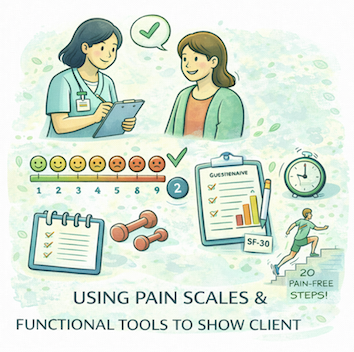
Pain scales are often your first and easiest outcome measure. They organize a subjective experience into a structured number or description you can track.
Common options:
- Numeric Rating Scale (NRS): “On a scale from 0 to 10, where 0 is no pain and 10 is the worst pain you can imagine, how would you rate your pain right now?”
- Visual Analog Scale (VAS): A line (often 10 cm) where the client marks their pain level; you measure the distance.
- Verbal descriptor scales: Words like “no pain, mild, moderate, severe, worst possible.”
Helpful tips:
- Anchor your questions: ask about pain “right now,” “at its worst in the last week,” or “on average in the past 24 hours.”
- Use the same version each visit so your data is comparable.
- Record both numbers and brief context: “7/10 by end of workday; 3/10 in morning.”
Example Pain Scale Table
| Time point | Pain rating (0–10) | Notes |
|---|---|---|
| Before first session | 7/10 | Worse after 8‑hour desk shift |
| After first session | 4/10 | Feels “lighter” in shoulders |
| One week later, before session 2 | 5/10 | Some return, but less intense |
| After fourth session | 2–3/10 | Rarely above 5/10, even on busy days |
Functional Tools: Measuring What Clients Can Do
Function-based outcome measures assess what a client can do in daily life, not just how they feel. This often matters more to clients than a pain number alone.
Functional tools can be:
-
Simple self-reports:
-
- “How long can you sit before pain forces you to move?”
- “How far can you walk before you need a break?”
- “How many workdays per week are affected by your symptoms?”
-
Standardized questionnaires (depending on your setting/scope and local regulations), such as disability indexes or region-specific function scales.
Even if you don’t use formal questionnaires, consistent functional questions help you see whether massage is improving real-world ability.
Simple Functional Tracking Table
| Activity / function | Baseline (first visit) | After 4 weeks |
|---|---|---|
| Sitting at desk before pain starts | 20 minutes | 45–60 minutes |
| Sleep interruptions from pain | 4–5 nights per week | 1–2 nights per week |
| Ability to lift groceries (self‑rated) | “Very difficult, need help” | “Manageable most of the time” |
Physical Measures: ROM and Tolerance
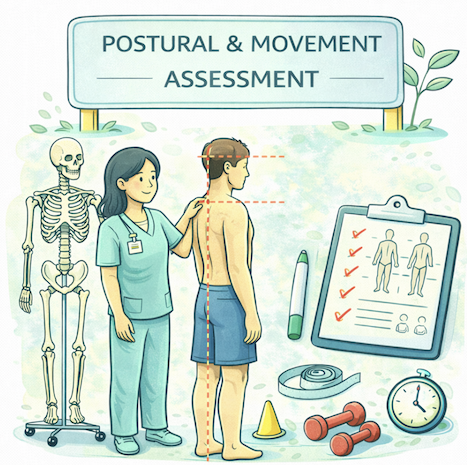
Within your scope as a massage therapist, you can also use simple physical measures:
-
Range of motion (active or passive):
-
- Neck rotation in degrees or as “fingertip to chin” distance.
- Shoulder flexion/abduction (“able to reach just above head,” “full overhead reach”).
- Lumbar flexion (“fingertips reach mid‑shin, ankles, floor”).
-
Tolerance tests:
-
- Time standing without symptom flare.
- Number of heel raises or squats (if appropriate and within scope).
Use clear, repeatable positions and instructions. Document what you see and what the client feels (pain, tightness, pulling, etc.).
Turning Outcome Data into Clinical Decisions
Outcome measures matter only if you use them to guide your choices. You combine:
- Pain ratings (better, worse, the same?).
- Function (more or less capable in daily tasks?).
- ROM/physical measures (improved, unchanged, or reduced?).
- Client’s subjective impressions (“I feel less stiff,” “I can concentrate better at work”).
If outcomes are improving:
-
You can gradually progress treatment (e.g., add more specific work, space sessions out more, increase self‑care emphasis).
If outcomes plateau or worsen:
- Reassess your working hypothesis (are you targeting the right region/tissues?).
- Adjust techniques, frequency, or focus (e.g., more relaxation vs. more specific work).
- Consider whether co‑management or referral is appropriate (e.g., physiotherapy, medical assessment, mental health support).
Scenario: Using Outcome Measures with a Client
Imagine a client, Sara, age 45, with chronic neck and upper back pain from office work.
Baseline (Visit 1):
- Pain: 7/10 at the end of a workday; 4/10 in the morning.
- Function: Can sit only 30 minutes before needing to change position; wakes 3–4 nights per week from pain.
- ROM: Cervical rotation limited ~25% to the right, with tightness but no sharp pain.
You record these values and design a plan focusing on upper back, neck, and chest soft‑tissue work, plus simple home stretches and break reminders.
After 3–4 sessions:
- Pain: Down to 4–5/10 at the end of the day; 2–3/10 in the morning.
- Function: Can sit 60 minutes before needing a break; sleep disruption now 1–2 nights per week.
- ROM: Cervical rotation improved, only ~10% limitation with mild tightness.
You show Sara the difference between her baseline and current scores, which reinforces her motivation and confidence in the process. You decide to start spacing sessions out to every 2 weeks, adding more focused self‑care instruction.
If, instead, Sara’s pain stayed at 7/10 and function did not improve after several sessions, the data would help you justify changing your approach or discussing referral.
Practical Tips for Students
To use outcome measures without overwhelming yourself or clients:
- Start small: pick 1 pain scale and 1 functional question related to the main complaint.
- Be consistent: use the same questions and timing (e.g., before each session, every 3–4 sessions).
- Write them clearly in your notes: include both numbers and short descriptions.
- Share results with clients: “When we started you were at 7/10 most days; now you’re usually at 3–4/10.”
- Remember: a small, meaningful change in function (sleep, work, daily activities) can matter more than a perfect pain score.
When you routinely track pain, function, and simple physical measures, you show clients—and yourself—that massage therapy is not just about a relaxing experience. It becomes measurable, goal‑directed healthcare, grounded in data that guides your ongoing clinical decisions.