Professional boundaries are the framework that keeps massage therapy safe, ethical, and therapeutic. They protect both client and therapist, clarify roles, and help you navigate the unique mix of touch, vulnerability, and power that exists in massage practice.
What Are Professional Boundaries?
Professional boundaries are the limits that define appropriate interactions between you and your clients. They separate your professional role from your personal life and ensure that every decision you make is in the client’s best therapeutic interest, not your own convenience or emotional needs. Boundaries apply to touch, time, money, self-disclosure, communication, and even how you use social media.
Key idea: you can be warm, caring, and human without becoming a friend, partner, or emotional caretaker for your client.
 Power Dynamics in Massage Therapy
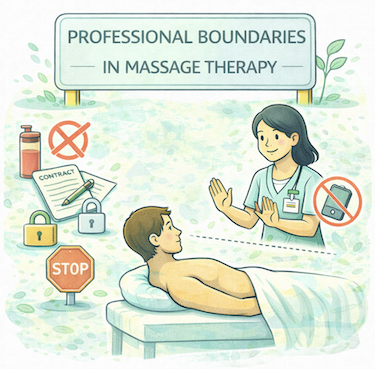
Massage therapy involves asymmetry: the client undresses (to some degree), lies on a table, and is often in a vulnerable physical and emotional state. You, as the therapist, are clothed, standing, and in control of the setting, schedule, and techniques. This creates a built-in power imbalance.
Being aware of this imbalance means you:
- Take extra care to explain what you’re doing and why.
- Invite questions and feedback regularly.
- Avoid any behavior that could be perceived as coercive, seductive, or exploitative.
- Remember that “They didn’t say no” is not the same as “They freely said yes.”
Clients may comply because they feel intimidated, obligated, or afraid of conflict. Your responsibility is to create an environment where “no,” “stop,” and “I’m not comfortable with that” are always welcome.
Boundaries Around Touch
Touch is your core tool—and also a major boundary area.
Professional touch is:
- Purposeful: Always linked to the treatment plan and client goals.
- Predictable: You explain what area you’ll touch and obtain consent.
- Time-limited: It happens within the session, not outside it.
- Neutral and non-sexual: No flirting, sexualized comments, or ambiguous behavior.
Best practices:
- Explain draping clearly and follow it consistently.
- Ask permission before approaching sensitive areas (gluteals, chest, abdomen, inner thigh) and accept “no” without pressure.
- Avoid massaging areas that are not clinically necessary, especially if it could be misinterpreted.
- Never use your role as a therapist to satisfy your own need for closeness, comfort, or validation.
Dual Relationships and Conflicts of Interest
A dual relationship exists when you have more than one role with the same person—for example, client and friend, client and coworker, or client and romantic partner. Some dual relationships are unavoidable (small communities, school clinics), but all require careful management.
General guidelines:
-
Avoid starting a therapeutic relationship with someone you’re dating, want to date, or have a close personal or financial relationship with.
-
If you must treat someone you know (e.g., small town, family connection), be transparent, obtain informed consent about the potential complications, and stick strictly to professional standards.
-
If romantic or sexual feelings develop (from you or the client), the professional relationship should end, with appropriate referral, before any personal relationship could be considered.
-
Never accept or pursue romantic or sexual involvement with a current client; in many jurisdictions this is a serious ethical and sometimes legal violation.
Ask yourself: “Whose needs are being met here?” If the answer is “mine,” your boundaries are likely being crossed.
Communication, Self-Disclosure, and Emotional Boundaries
Good therapeutic communication is clear, respectful, and client-centered—but not over-sharing or emotionally enmeshed.
Healthy communication looks like:
-
Using appropriate, respectful language (no sexual jokes or suggestive comments).
-
Keeping the focus on the client’s experience, not your own problems or personal life.
-
Using small, carefully chosen self-disclosures only when they benefit the client (e.g., normalizing a common concern), not to seek support or attention.
-
Ending sessions on time, even if a client wants more time to talk or vent.
Emotional boundaries mean you can be empathetic without taking on the client’s feelings as your own. You listen, validate, and respond professionally, but you do not become their therapist, savior, or best friend.
Practical Scenarios and How to Respond
Here are a few common situations and boundary-respecting responses.
-
Client asks to be your friend on social media.
-
Response: “Thank you for the connection. To protect your privacy and keep my professional boundaries clear, I only use this account for personal contacts. We can always communicate through the clinic.”
-
-
Client frequently gives you expensive gifts.
-
Response: “I really appreciate your kindness. However, I need to decline gifts of this value to keep our professional relationship clear. Your thanks and feedback are more than enough.”
-
-
Client makes flirtatious or sexual comments.
-
Response: “That comment feels inappropriate in a professional setting. My role here is to provide therapeutic massage. If we can’t keep the session professional, I’ll need to end today’s treatment.”
-
-
You feel strong attraction toward a client.
-
Internal action: Acknowledge it honestly to yourself, tighten your boundaries (touch, conversation, scheduling), consult a trusted supervisor/mentor, and, if needed, plan a respectful referral out. The client must never be used to meet your emotional or physical needs.
-